

How Do We Prevent Cross Contamination Between The Dirty Side Of The Dish Machine And The Clean Side?
The subject is cleaning and sanitizing. Chefs, food service directors, managers and staff try to do safe food-treatment at every turn in the kitchen. Don't let that endeavour go downwardly the drain by slacking off on the many aspects of sanitation. That includes dish and ware-washing techniques (pots, pans, equipment), and cleaning all the areas that give u.s. that "great as a pin" appearance in your customers eyes. Customers seldom fail to bring that soiled silverware or drinking glass with lipstick on it to the attending of the director or wait staff. Improperly cleaning and sanitizing of food contact equipment does allow transmission of pathogenic microorganisms to food and ultimately our client.
Cleaning vs. Sanitizing – Cleaning is the process of removing nutrient and other types of soil from a surface (what yous can encounter). Sanitizing is the process of reducing the number of microorganisms on a clean surface to safe levels (removing microorganisms you cannot run across). Both tin can be done with estrus or chemicals. Sometimes we misuse terms regarding sanitation, then to further clarify definitions for killing microorganisms, disinfection and sterilization methods are much higher levels of microorganism devastation than sanitizing. They are done by higher heat, college chemical concentration or merely stronger chemicals. Disinfection might exist used for non-food contact surfaces such every bit floors or walls. Sterilization is used on medical equipment and some food processing equipment, but not in a kitchen environment.
Whatever surface that comes in contact with nutrient such equally a cut board or utensil must be cleaned and sanitized:
- Afterward each apply of that piece of equipment.
- Anytime you begin working with another type of food – special care is needed betwixt raw food and prepare-to-consume food grooming.
- Anytime you are interrupted during a task and the tools or items you take been working with may have been contaminated. Busy rush periods or receiving deliveries might exist examples.
- At four-60 minutes intervals if the nutrient contact equipment is in constant apply. A skillful case is a cafeteria slicer or knife, but hopefully you clean and sanitize heavily used equipment even more often than the 4 60 minutes maximum to help command cross-contamination.
Dishwashing Car Operation—For the best cleaning, outset with the right equipment. Pots and pans ordinarily demand manual 3 compartment sink process. Dishes, glassware, and flatware are best washed in a commercial automatic dishwasher. Option of the correct car depends on several factors, including the overall volume and type of wares to launder and sanitize. Dish machines range in size from single-tank, stationary-rack units to flight-type conveyor units. According to the National Association of Foodservice Equipment Manufacturers, dish machines are rated by the number of racks loaded with an average of xx dishes that can be properly washed per hour. Information technology's critical to match the machines rating to your real-life dish count.
Operators can choose 'high-temperature" or" depression-temp" machines. High-temp sanitize using very hot water. Their rinse wheel must be at least180°F, although no higher than 194°F. Temperatures of 195°F and in a higher place can cause food particles to "bake" onto the dish surface from the steam. Machines using chemic sanitizers operate at lower temperatures (120°F) and utilize chlorine to sanitize that is injected into the final rinse. Even though machines are "automated", their efficiency is dependent upon the human being cistron – dish-room personnel, so call up these points:
- Check the machine for cleanliness at least once a solar day, cleaning information technology equally necessary. Fill the tanks with make clean water, clear the spray nozzles, and fill the detergent, rinse aid, and sanitizer dispensers properly.
- Scrape, rinse, or soak items before washing. Pre-soak items with dried on food particles.
- Load dish racks correctly and don't overload them. Make sure all surfaces are exposed to the spray action of the machine.
- Cheque temperatures and pressure ofttimes post-obit the manufacturer's recommendations.
- Check each rack every bit it comes out of the automobile for soiled items and run dirty items through over again until they are clean.
- Air dry all items. Place spectacles, cups, pots and pans upside down on the drying rack. Place and store flatware and utensils with handles upward.
- Handwashing is of import for the crew in the dish room if i person is loading dirty dishes and also removing make clean dishes from racks. Train the crew how to best control this pace.
Three Compartment Sinks –Pots, pans, utensils, and bar glassware are typically washed manually in a three-compartment sink. All sinks should exist rinsed and cleaned prior to employ. The showtime sink is for pre-soaking and washing. At to the lowest degree 110°F (as hot as you can stand) will assistance the detergent work. Earlier filling the 2d and 3rd sinks, scrape any pots and pans that need presoaking and place them in the filled first sink. Those extra minutes in the hot water will assistance loosen the stale-on particles. Fill up the 2d sink – the rinsing compartment—with warm water too (at least 110°F). So fill the third sink – the sanitizing compartment. Measure your sanitizer accurately considering the gallons of water in the 3rd sink. Based on the sanitizer manufacturer's recommendations and label instructions, utilize h2o temperature of 75°F to 120°F to sanitize. Do non rinse off the sanitizer. Air dry out all equipment – do not towel dry.
Sanitizer effectiveness is based on three factors: 1) concentration of the solution in water; two) water temperature; and three) contact time with the dishes. Sanitizers must be EPA registered. Test kits are required by the FDA Food Code and the regulatory agency that inspects your facility. Chlorine and quaternary ammonium sanitizers are the most common in food service. Chlorine-based sanitizers should be 50-100 parts per million (ppm's) concentration and contact time is seven seconds or more. Quaternary based sanitizers are commonly 150 to 200 ppm's concentration and thirty seconds contact fourth dimension. All chemic sanitizers have pros and cons regarding characteristics such as kindness to skin, staining, smell, power to work in hard water, effects on metal, and price per use, so ask your chemical supplier to assistance you make the correct choice.
Some additional hints for the dishwashing process: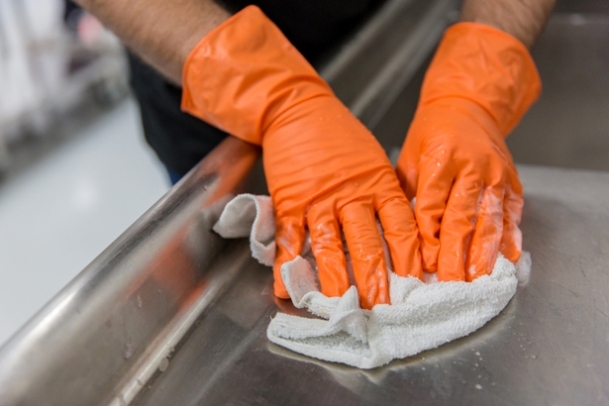
- Wear heavy-duty, longer length, nitrile pot sink gloves to protect your hands for dishwashing applications.
- Keep sanitizer test kits handy and occasionally cheque the temperature of the washing and sanitizing solutions.
- Modify the rinse water whenever it becomes cloudy. Avoid merely running hot water as the rinse pace. It's time-consuming and wasteful.
- Wash hands thoroughly before and subsequently performing dishwashing duties.
Bottom Line : So, as the title says, "don't compromise – make clean and sanitize".
***
About the Author: Lacie Thrall

Lacie Thrall passed abroad in early 2022 subsequently a long illness. She dedicated her 35-yr career to improving the health and well-beingness of others by promoting food safety best practices. Lacie worked in environmental wellness for 17 years before joining FoodHandler in 1997 as the Managing director of Condom Management. While at FoodHandler, she trained employees and customers on safe nutrient treatment practices, including proper hand hygiene and glove use. Later as a FoodHandler consultant, Lacie provided the foodservice industry with food safety information and advice through her blog on FoodHandler.com.
Championship

Source: https://www.foodhandler.com/clean-and-sanitize/
Posted by: turnerandist.blogspot.com
0 Response to "How Do We Prevent Cross Contamination Between The Dirty Side Of The Dish Machine And The Clean Side?"
Post a Comment